What does land clearing in Augusta involve?
Land clearing removes trees, brush, stumps, and debris so a lot can be graded, built on, or opened up. The work is cutting, grinding or pulling stumps, and hauling or chipping what comes out. The part that is easy to get wrong is what the ground does afterward.
Bare Augusta soil is not stable ground. A cleared lot on a slope can lose its topsoil in one storm, and a creek three hundred feet downhill takes the blame. A good clearing job is planned from the erosion end back, not from the chainsaw end forward.
If your goal is a building pad, a driveway, or a pond, clearing is the first of several steps. See lot grading and site preparation for what follows, or pond digging if water is the goal.
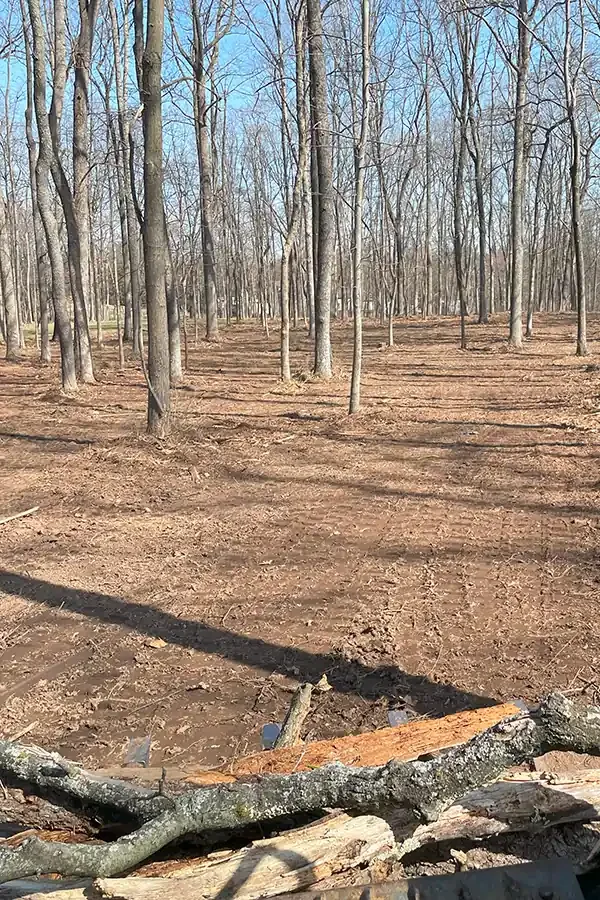
What can we clear, and what do we leave alone?
Every lot is a list of decisions about what stays. We walk the land with you and flag the trees you want to keep before any machine starts. Shade trees near the house, large hardwoods along a property line, and anything on a neighbor's side are usually marked to stay.
- Trees and brush. Cut, stacked, chipped, or hauled.
- Stumps. Ground below grade or pulled with the root ball.
- Undergrowth. Mulched in place on open ground, or raked out where it is thick.
- Old fences, footings, and debris. Removed and hauled on request.
- Small structures. Sheds and outbuildings, covered below.
What we do not do is cut inside the stream buffer, take down a tree that belongs to someone else, or clear first and ask about permits later.
Why does clearing red clay need a plan?
The Piedmont side of Augusta sits on weathered rock that has turned into the red clay Georgia is known for. The New Georgia Encyclopedia describes that layer, called saprolite, as highly erodible when its vegetation is removed, and notes that clearing farmland in the past led to rapid erosion. The same thing can happen on a cleared home lot.
South of the Fall Line the ground is sand, which moves differently. It drains quickly but it also washes and blows. The Augusta dirt guide explains the difference. Either way, the plan looks the same.
We walk the lot for slope, the low spot where water leaves, and any creek or wet area. Sediment controls go on the downhill side, set along the contour, with the ends turned uphill so water cannot run around them.
We leave the root mat and ground cover in place wherever the end plan allows it. A lot that will not be graded for months should not be scraped to bare clay in the meantime.
Bare areas get seed and mulch or straw. We look at the silt fence after each hard rain and clean it out when sediment builds up against it, because a full fence stops working.
The Georgia Soil and Water Conservation Commission publishes the state erosion and sediment control manual that local inspectors check against. We follow it on every job where ground is disturbed.
Should the stumps be ground or pulled?
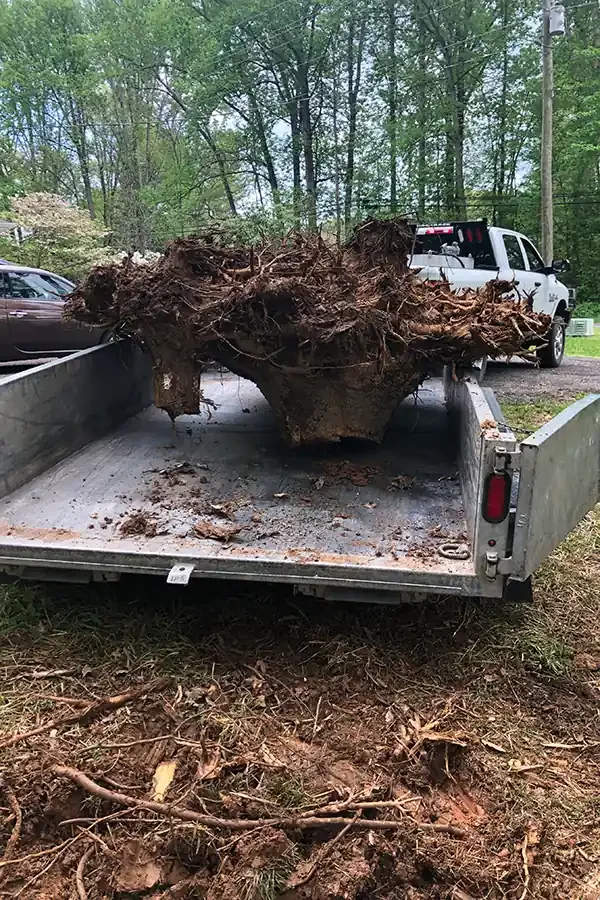
It comes down to what happens on that spot next. If the area will be lawn, a ground stump is faster and cheaper, and the chips can stay or go. If a foundation, a pad, or a driveway is going over it, you want the roots out, and that means pulling the stump and backfilling the hole in compacted lifts.
A large oak root ball can weigh more than a pickup truck. That is why the trailer in the photo above is loaded by machine and not by hand. We tell you before we start whether a stump is a one-hour job or a half-day one.
- Lawn or open ground: grind.
- Building pad, slab, or driveway: pull and backfill.
- Next to a septic field or utility line: hand-expose first, then decide.
What rules apply before we clear?
Georgia law treats clearing, grading, excavating, and filling as land-disturbing activity, and the state expects a local permit or notice before it starts (O.C.G.A. 12-7-7). In Augusta, the Planning and Development Department, at 535 Telfair Street, Suite 300, (706) 821-1796, issues grading permits, and its ordinance requires a soil erosion plan for sites over 1.1 acres. The ordinance text we have on file is from 2011, so we confirm the current rules with the office on each job.
In Columbia County, erosion inspections run through the Stormwater Compliance Department in Evans at (706) 447-7645. The permit tool sorts these out by address and job.
The state buffer is separate. Georgia's manual keeps land disturbance 25 feet back from state waters unless the state grants a variance, and trout streams get 50 feet. Neither one is something a clearing contractor can waive.
Can you take down a shed or small outbuilding?
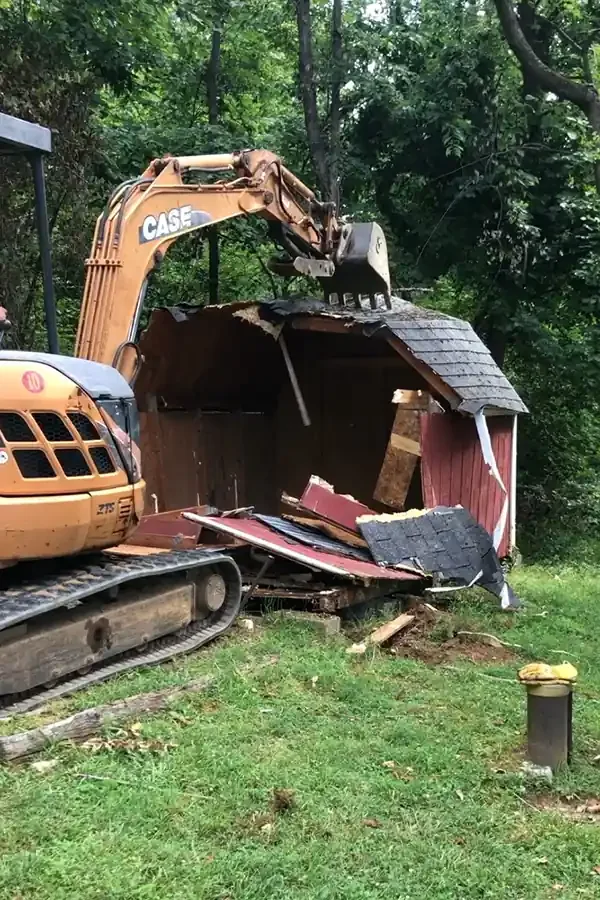
Yes. An excavator can pull a shed, a lean-to, or an old outbuilding apart quickly, then load the pieces and haul them. The slab or footing is the part people forget, so we price the removal of the slab if there is one and level the spot afterward.
Before we start we confirm with the Augusta License and Inspections office whether a demolition permit applies to the structure, because that depends on what it is and where it sits. Utility lines to an outbuilding, such as power or a water spigot, are located and shut off first.
Demolition of houses and larger buildings is outside what this page covers. Ask us, and we will say whether it is a job we take.
How a clearing job runs
Walk and flag
We walk the lot with you, flag every tree that stays, and mark the stream buffer if there is one.
Permit check and 811
We confirm the office for your parcel, pull the permit if the work needs one, and call 811 so utility lines are marked.
Controls in first
Silt fence goes on the downhill side before the first cut.
Cut, grind, pull, haul
Trees come down, stumps are ground or pulled, and debris is chipped or loaded out.
Stabilize
We seed and mulch what we exposed, then walk it with you and leave it ready for grading or building.